We Taught You to Climb the Ladder. Nobody Taught You to Read the Lattice.
What seven years in a Security Operations Center and one semester as a professor taught me about the education Indian students actually need

I have sat on both sides of the same room.
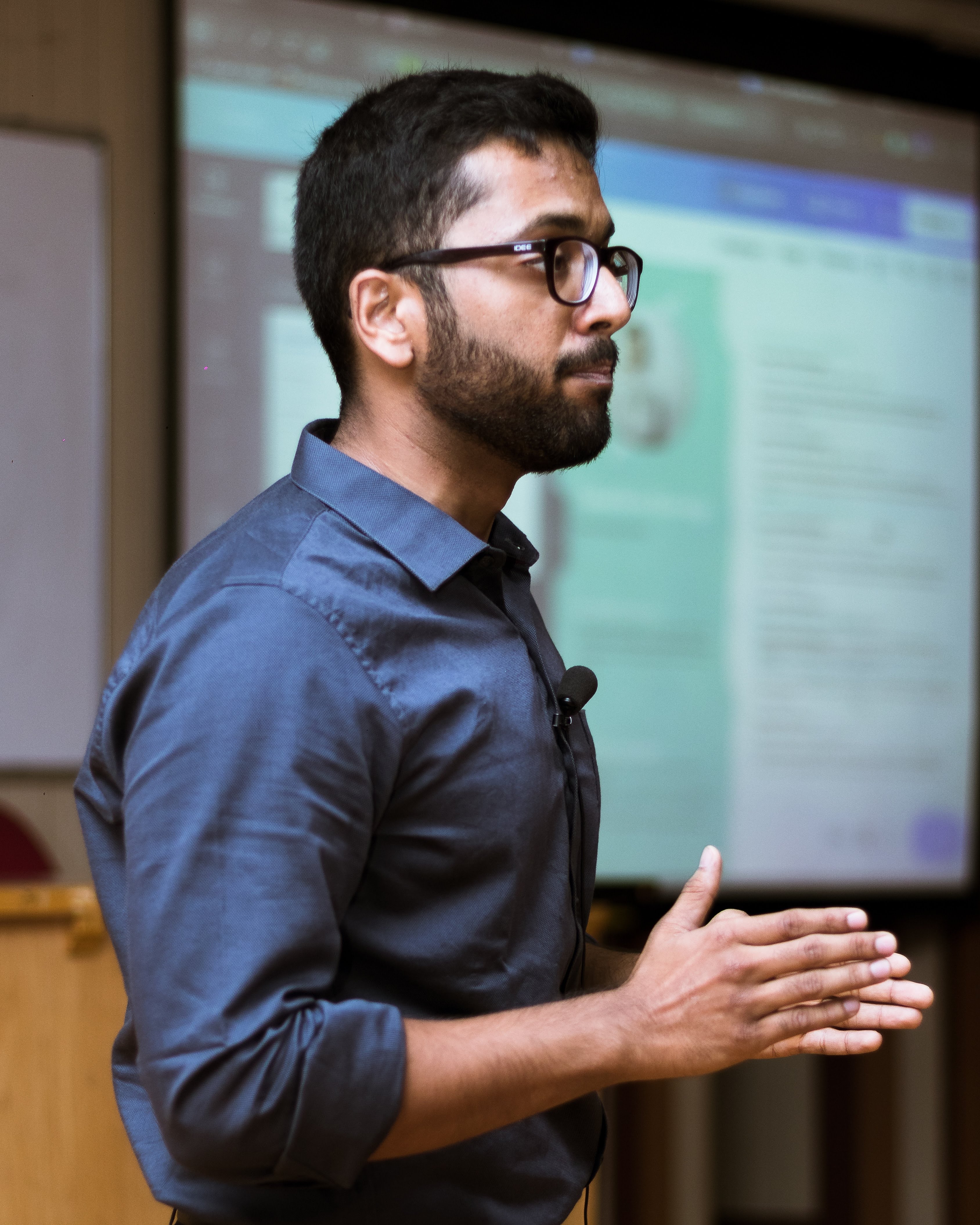
For four years, I sat in the student's chair, taking notes, submitting assignments, memorizing what would be asked on the exam, and rarely questioning the shape of the system I was in. Today, I stand at the front of a classroom at my own alma mater, BMS College of Engineering, as a visiting professor. Same building. Same kind of chalk dust in the air. Completely different vantage point.
And somewhere between those two chairs, I spent nearly seven years inside Akamai's Security Operations Command Center, where I now lead a team that responds to some of the largest DDoS attacks on the internet.
That combination former student, current professor, working security architect has left me with a question I can't quite put down.
What if we're doing an excellent job preparing students for college, but a much weaker job preparing them for what comes after? The Book That Made Me Look Backward
I recently read Adam Grant's Hidden Potential. It's not a book about education systems or Indian colleges. It's a book about how people actually grow, and one idea in it kept following me around for days.
Grant argues that potential isn't just about what you already know. It's about how you respond when you don't know something. How you seek help. How you adapt when the situation doesn't match anything you've prepared for.
I put the book down and thought about my own students. Bright, hardworking, sincere. Many of them can solve a problem beautifully as long as it looks like the problems they've already practiced.
But the moment a problem doesn't match the syllabus, something changes. The confidence dips. The hand doesn't go up. And I recognized that hesitation immediately, because I used to be that student too.
That's when this article was born. Not the book itself, but the reflection it triggered.
The Shape of the System I Grew Up In

Let me be clear about something before I go further: I am not here to say Indian education is broken. I don't believe that, and I think that argument is too easy and, frankly, a little lazy.
Structure matters. Deadlines matter. Rules, evaluation, and academic standards exist for good reasons; they built the discipline I still rely on today. I am not interested in tearing any of that down.
But I do think the shape of what we teach students to navigate deserves a second look.
For most of my education, the flow of information looked something like this:
Professor → Student → Assignment → Exam → Marks
Information moved in one direction. Down. My job was to receive it, retain it, and return it in the format the exam expected. Success meant knowing the right answer before anyone asked.
That's a hierarchy. And hierarchies are excellent at one thing: producing consistent, predictable outcomes across many people. That's exactly what a classroom of 60 students needs.
It's just not what the real world looks like.
The Shape of the Problems I Actually Solve

Here's what a real problem looks like in cybersecurity.
A customer calls in during an active attack. To resolve it, the path might run through:
Customer → Engineer → Security → Product → Manager → Documentation → Engineering → back to the Customer
Notice what's missing from that sentence: a single, obvious "correct" direction. Nobody at the start of that chain knows exactly who will end up solving it. The junior engineer on shift might spot the pattern before the fifteen-year veteran does, simply because they saw something similar three weeks ago. The answer doesn't live at the top. It lives somewhere in the network, and the job is to find it.
I don't think of that shape as a hierarchy anymore. I think of it as a lattice, a structure where people connect across levels, teams, and disciplines, not stacked neatly on top of one another.
In a lattice:
A junior analyst can teach a senior architect something they missed.
A colleague two teams away might hold the exact piece of context you're missing.
Expertise on a specific problem doesn't always correlate with seniority.
Information can travel sideways just as easily as it travels down.
And the question that matters most quietly changes. It stops being "who is above me?" and becomes "who can actually help me understand this?"
That single shift in the question you instinctively ask might be the most useful thing I've unlearned since I graduated.
In College, You're Trained to Ask One Question
In the classroom, we train students, often without meaning to, to ask:
What is the correct answer?
It's a reasonable question inside an exam. It becomes a limiting one outside of it.
At work, the more useful questions sound different:
Who has seen this before?
What information are we actually missing right now?
How do we even begin to figure this out?
None of those questions have an answer key. And that's precisely the point: most real problems don't come with one.
I don't think this gap is anyone's fault. It's simply what happens when a system optimized for evaluating 60 students at once meets a workplace that runs on ambiguity, ownership, and collaboration across disciplines. Those are two very different design problems, and we've mostly only built for the first one.
What I'm Trying to Change, One Semester at a Time
I want to be honest about something: I'm not trying to dismantle the system I teach inside. I don't think that's realistic, and I don't think it's even the right instinct. What I'm trying to do is expand the space inside the boundaries that already exist.
A few principles I keep coming back to in my own classroom:
1. Give problems, not just answers. A solved example teaches a method. An unsolved problem teaches a way of thinking. I try to leave more room for the second kind.
2. Make the classroom more horizontal. Some of the best explanations I've seen happen when one student explains a concept to another in language I would never have used myself. I try to create more of those moments on purpose, instead of treating them as a distraction from "real" teaching.
3. Reward the question, not just the correct answer. A sharp question, asked before the student has any idea what the answer is, should carry real value in the room. That's often where the real thinking happens.
4. Teach students how to find answers, not just recite them. The ability to research, test, ask, and investigate outlasts almost anything memorized for a single exam.
5. Teach students how to navigate people, not just content. Whom do you approach with a problem? How do you explain something you don't fully understand yet? How do you disagree with someone respectfully? How do you say "I'm not sure" out loud, in a room, without it costing you anything? These are professional skills, and almost nobody teaches them directly.
6. Keep the rules. Expand the space inside them. Deadlines stay. Standards stay. Accountability stays. But within those boundaries, there should be room to experiment, to be wrong in a low-stakes way, and to think out loud.
None of this is radical. It's closer to a recalibration.
The Line I Keep Coming Back To
If there's one idea I'd want a reader to leave with, it's this:
The goal isn't to remove hierarchy. It's to make hierarchy less of a bottleneck.
This matters even more in a field like mine. In cybersecurity, rules, escalation paths, ownership, change management, and compliance aren't bureaucratic friction; they're what keeps a system safe under pressure. I would never argue for ignoring process in the name of "collaboration." That's not lattice thinking. That's just chaos with better branding.
What I've learned to do instead is simple, even if it took years to internalize:
Follow the process. Respect the ownership. Understand the rules. But don't let any of that stop you from learning from someone outside your immediate circle when you need to.
Structure and connection aren't opposites. The best environments I've worked in have both, at the same time. Not structure or freedom structure with room to move inside it.
The Sentence I Want My Students to Remember
I don't actually want my students to remember the answers I gave them in class. Most of those will be outdated or irrelevant within a few years anyway; that's simply the nature of a fast-moving field like cybersecurity.
What I want them to carry with them is a small shift in language. From:
I don't know.
to:
I don't know yet. Let me find out.
That one added word, yet, changes almost everything about what comes next. It turns a dead end into a starting point. It's the difference between a student who freezes when a problem doesn't match the syllabus, and a professional who calmly starts asking who else might have seen this before.
I didn't learn that sentence in college. I learned it years later, standing in front of a live attack dashboard, realizing nobody in the room had the full answer and that the only way forward was to find someone who had part of it.
The Question Worth Sitting With
So here's the question I keep returning to, and I don't think it has a clean answer:
Are Indian colleges preparing students to navigate the world or mostly preparing them to navigate college?
I don't think the honest answer is "the system is broken." I think it's closer to: we've built something very good at one job, and we've quietly asked it to also do a second job it was never designed for.
Are we optimizing students for examinations, when their actual careers will require them to operate in environments with no answer key at all?
I think that's worth sitting with, whether you're a student, a professor, a manager, or someone who's simply trying to figure out what your own education did and didn't prepare you for.
Where This Leaves Us
I don't want to teach students how to survive college.
I want to help them become the kind of people who can navigate whatever comes after it the ambiguous problem, the cross-team escalation, the moment when nobody in the room has the full picture and someone has to go find it.
That's not a rejection of structure. It's just an argument for building a little more lattice into it.
A question for you
What did college teach you well and what did you only end up learning after you actually entered the workplace?
I'd genuinely like to know. Drop it in the comments, or reply if you're reading this in your inbox I read every one.


Comments